
Drug rehab advertising aimed at people in the US runs on Google, Meta (Facebook and Instagram) and Microsoft Advertising only after LegitScript certification, and Google and Meta each add an approval of their own. TikTok’s published healthcare policy does not confirm addiction-treatment eligibility, so check with TikTok before planning ads.
Rules at a glance: what each platform asks of a US addiction treatment provider
| Platform | US eligibility | Required approvals | Key restriction |
|---|---|---|---|
| Google Ads | Allowed for approved advertisers | LegitScript certification, then certification with Google | Advertiser-curated audiences (remarketing lists, Customer Match, lookalikes) can’t be used |
| Meta (Facebook, Instagram) | Allowed for ads targeting the US | LegitScript certification, then prior written permission from Meta | Permission is a separate request in Meta Business Suite |
| Microsoft Advertising (Bing) | Allowed, US only | LegitScript certification | Landing pages and ad URLs must be certified; no lead generation ads; 18+ audiences |
| TikTok | Addiction-treatment eligibility not confirmed | Requirements not confirmed for addiction treatment | Nearest category, “Medical institutions” (our reading), requires local-law compliance and 18+ targeting |
Sources checked 13 October 2026. LegitScript certification “does not guarantee advertising approval.” Recheck the linked policies before applying.
Outcome: you can identify each platform’s approval requirements and where eligibility remains unconfirmed.
LegitScript eligibility before you apply
LegitScript certification is the shared gate for Google, Meta and Microsoft. LegitScript calls itself “the only certification and monitoring solution recognized by Google, Meta, Microsoft and Nextdoor to vet addiction treatment advertisers.”
Does your type of organization qualify? Being named in a platform’s restricted category is not the same as being able to get certified. Google, for example, names sober living and referral agencies in scope, but its US rule adds that services not eligible for LegitScript “are not allowed to advertise for drug and alcohol addiction services on Google.”
| Organization type | LegitScript position |
|---|---|
| Licensed clinical treatment (detox, residential, outpatient, counseling, MAT) | May qualify |
| Mutual support groups run by non-licensed peers | May qualify, but not sober living homes that run groups |
| Crisis hotline | May qualify, if it does not promote specific providers |
| Sober living or recovery residence without licensed clinical services | Does not meet requirements |
| Lead generator, call center or marketer paid to refer patients | Explicitly disallowed |
Affiliation matters too. LegitScript’s standards say co-ownership of, or any formal or informal affiliation with, a lead generator “is prohibited and may be grounds for immediate denial”, including sponsoring or answering a lead generator’s hotline. How referral partners are paid is also a legal question; our addiction treatment marketing compliance guide covers that side.
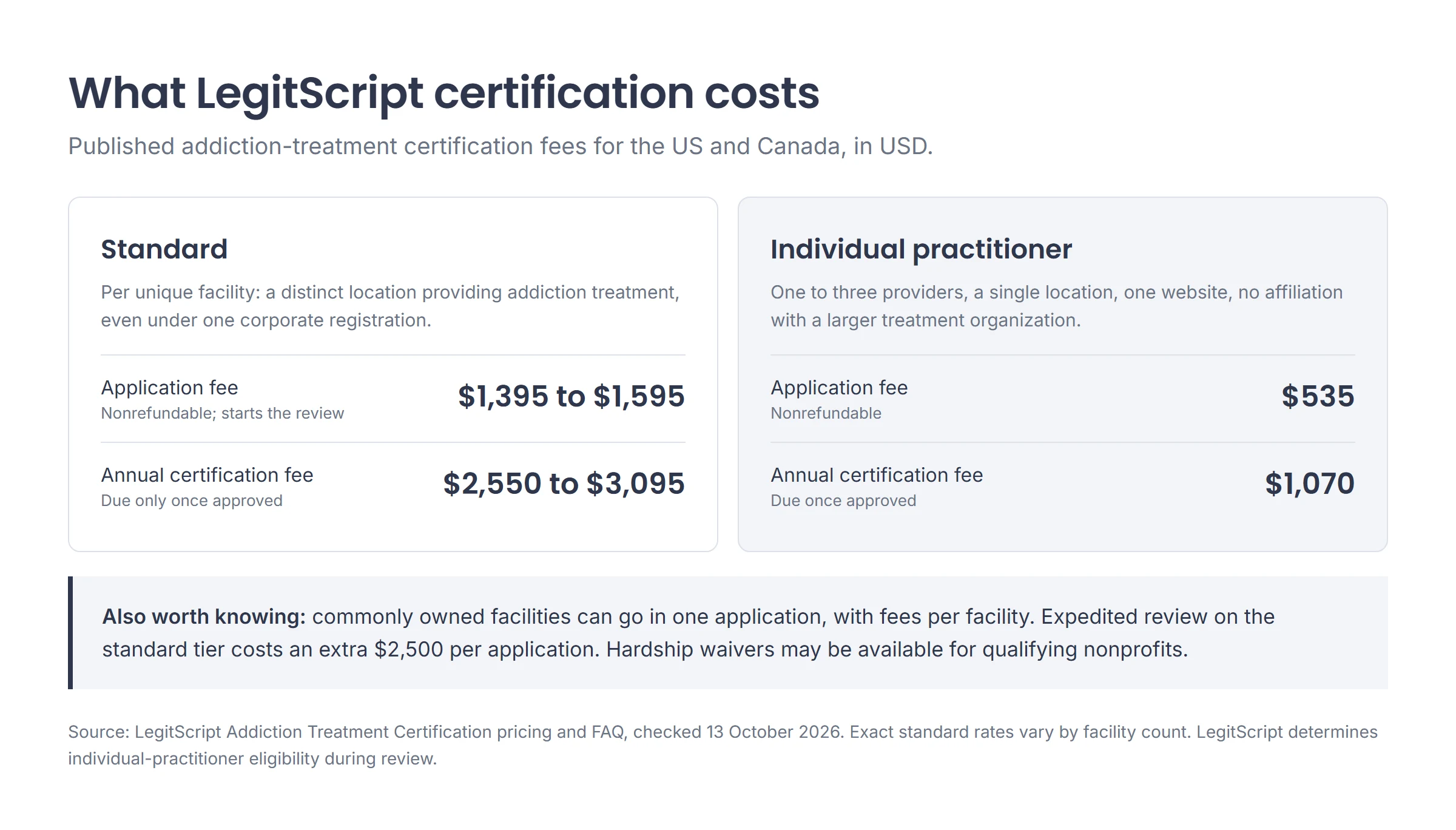
Cost and coverage: LegitScript lists a nonrefundable application fee of $1,395 to $1,595 per facility and an annual fee of $2,550 to $3,095 after approval. Amounts are in USD, with rates based on facility count. Practices with one to three addiction-treatment providers, one location, one website and no affiliation with a larger addiction-treatment organization may qualify for individual-practitioner pricing: $535 to apply and $1,070 annually. LegitScript determines eligibility during review. Facilities under common ownership can go in one application, with fees per facility, and nonprofits may qualify for hardship waivers.
Outcome: you can check your organization type, fees and affiliations against LegitScript’s eligibility requirements before applying.
Google Ads for drug rehab: two approvals, not one
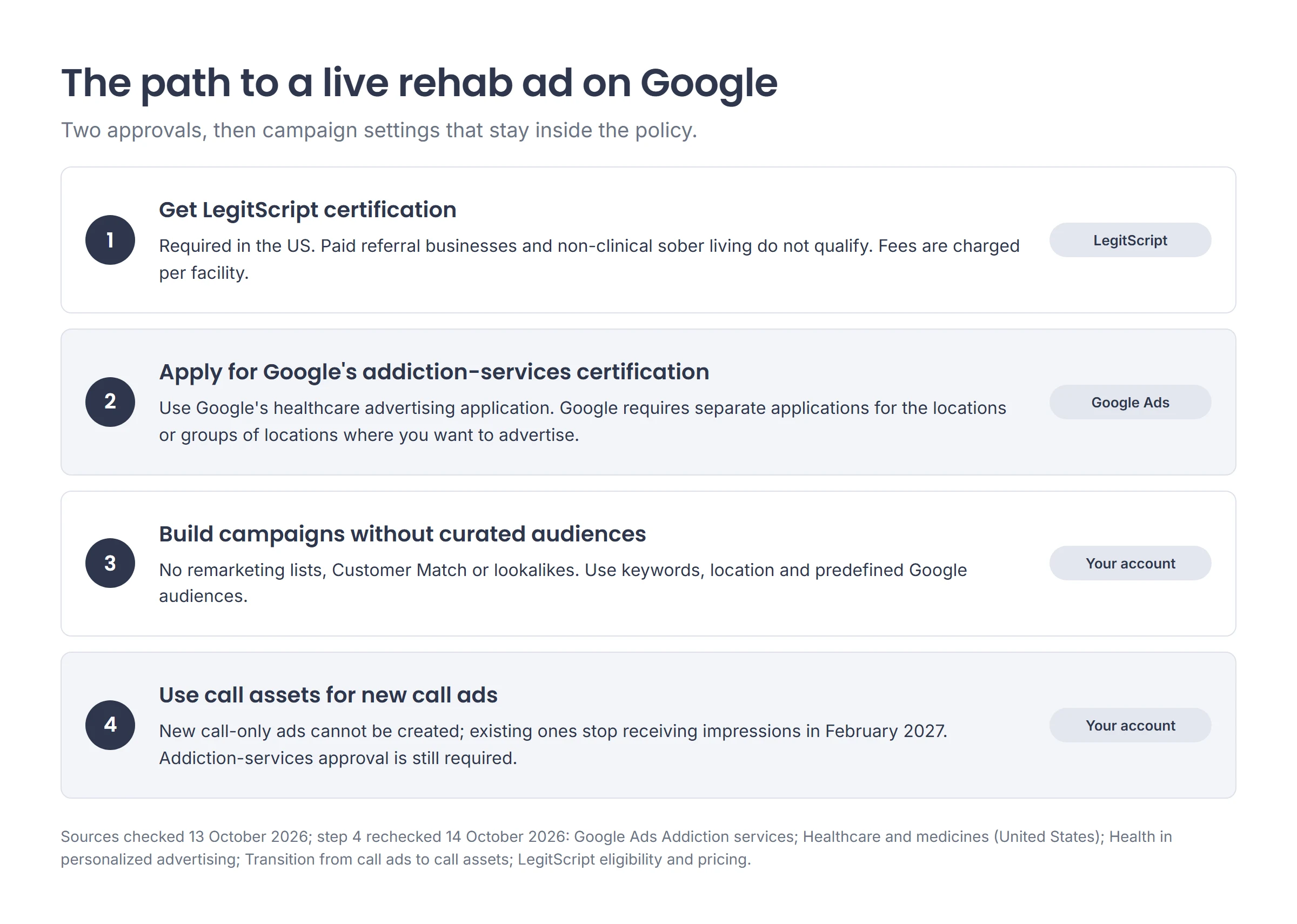
You can run Google Ads for a drug rehab in the US only with two separate approvals. Google’s US rule says you “must be certified as an addiction services provider by the LegitScript Certification program”, then adds: “Advertisers must also be certified with Google.”
- What’s covered. Google’s “Addiction services” policy covers clinical treatment providers, recovery support such as sober living and mutual help organizations, lead generators and referral agencies, and crisis hotlines. Impulse control disorders, behavioral addictions and nicotine are outside it.
- Where. Approved advertisers can run these ads in Australia, Canada, France, Ireland, New Zealand and the United States, each with its own conditions. In Google’s words: “If you want to advertise in more than one location, submit a separate application for each location or group of locations.”
- How to apply. After LegitScript certification, use Google’s healthcare advertising application. If a rehab center’s Google Ads are disapproved for missing Google’s certification, apply once you meet the requirements.
- Calls. For new ads focused on phone calls, use responsive search ads with call assets. Google removed new call-only ad creation in February 2026; existing call-only ads stop receiving impressions in February 2027. Addiction-services approval is still required.
- Audiences. Google’s sensitive Health category includes “Counseling services for mental health issues like depression, anxiety, and addiction”. For these ads, “You can’t use advertiser-curated audiences”: no remarketing lists of site visitors, no Customer Match uploads, no lookalikes. Predefined Google audiences such as in-market and affinity segments remain available, along with keyword and location targeting. What your site’s tags may collect is a privacy question, covered in the compliance guide.
Outcome: you file the right applications, use the call format Google still supports, and keep campaigns inside its audience rules instead of losing time to disapprovals.
Facebook and Instagram ads for addiction treatment
Facebook and Instagram ads for addiction treatment targeting people in the US need LegitScript certification and Meta’s written permission. Meta’s policy: “Advertisers can run ads for drug and alcohol addiction treatment in the United States as long as they’re certified with LegitScript and have written permission from Meta.”
- The second gate. LegitScript certification alone is not enough. Meta’s Business Help Center says you apply for permission through the verification and authorizations tab in Meta Business Suite settings, and its policy page also links a request form.
- What it covers. In-person treatment, addiction hotlines, mutual support groups, and online treatment such as recovery apps. Physical rehabilitation is exempt from this addiction-treatment permission requirement.
- Outside the US. Meta’s page sets out the US requirements and does not describe a route for other countries, so check with Meta before targeting elsewhere.
Outcome: you know where to request Meta’s separate permission before running ads.
Microsoft Advertising: certified URLs and lead generation rules
Microsoft allows drug and alcohol addiction recovery ads in the United States only, for LegitScript-certified advertisers, naming rehab facilities, group therapy, sober living and halfway houses. Two lines need checking before launch: “Landing pages and any URLs utilized in the ad must be certified” and “Lead generation ads are not allowed.”
Before launch, check that the landing pages and URLs used in your ads are covered by certification, and ask Microsoft to confirm any uncertainty about a tracking URL. Microsoft’s general healthcare rules add two audience limits: “Advertising must target users ages 18+,” and advertisers must not target consumers based on sensitive health information.
Outcome: you have checked your ad URLs and adult-only targeting against Microsoft’s requirements.
TikTok: confirm eligibility before planning ads
TikTok’s Healthcare and Pharmaceuticals policy (last updated September 2026) has no rule written for addiction treatment and does not mention LegitScript for it. The nearest US category is “Medical institutions”, which “May be allowed” if you comply with local laws, provide certifications where required, and restrict ads to people 18 and older. Treating a rehab as a medical institution is our reading, not TikTok’s wording. A missing rule is not a permission, so confirm with TikTok before you build creative or budget around it.
Outcome: you know what TikTok’s policy says, and doesn’t, before you commit spend.
While advertising applications are pending
Certification and platform approvals take time. While paid-ad applications are pending, our SEO guide explains the separate organic work our addiction treatment SEO service supports. Eligible facilities can also apply to SAMHSA’s FindTreatment.gov, which requires state licensure or equivalent approval, credentialed staff and authorization to bill third-party payers, with one application per service address.
Outcome: you know what work can start while approvals are pending.
Frequently asked questions
Can you advertise drug rehab on Google without LegitScript?
No, not in the US. Google requires LegitScript certification and separate certification with Google for recovery-oriented drug and alcohol addiction services. Services that are not eligible for LegitScript certification are not allowed to advertise addiction services on Google, whatever the campaign type or ad format.
Do Facebook ads for drug rehab centers need anything beyond LegitScript?
Yes. For ads targeting people in the US, Meta requires LegitScript certification and prior written permission from Meta, requested in Meta Business Suite settings or through the form on Meta’s policy page. Until permission is granted, certification alone will not get addiction treatment ads approved.
Does LegitScript certification guarantee my ads will be approved?
No. Certification is one eligibility step. Google and Meta still require their own approvals, and each platform assesses ads against its policies. Check the rejection reason before deciding whether the issue is certification, permission, the ad or its destination.
Does certification cover all our facilities and websites?
Not automatically. LegitScript allows a shared application for commonly owned facilities, with fees per eligible facility; additional locations still need review. Microsoft requires certification for landing pages and URLs used in ads. Google’s application requirements for each location or group of locations where you advertise are separate from LegitScript’s facility coverage. Check both scopes.
Can I retarget people who visited my rehab website?
Not through Google’s advertiser-curated audiences. For addiction-treatment ads, predefined in-market and affinity audiences remain available, as do keywords and location targeting. That does not permit targeting based on someone’s addiction history. Microsoft also prohibits targeting based on sensitive health information.
What should we check if ads are rejected after certification?
Start with the rejection reason. Check Google’s certification or Meta’s permission where required. On Microsoft, check certification for the landing pages and URLs used in the ad. Correct any policy violation; if the decision appears mistaken, use the platform’s appeal or policy support route.
Outcome: you know which approval or coverage issue to check next.
Sources
Sources checked 13 October 2026; corrected passages rechecked 14 October 2026.
- Google Ads: Addiction services policy
- Google Ads: Healthcare and medicines policy (United States section)
- Google Ads: Health in personalized advertising
- Google Ads: Transition from call ads to call assets
- Meta: Drug and Alcohol Addiction Treatment ad standard
- Meta Business Help Center: About Meta’s Drug and Alcohol Addiction Treatment advertising policy
- Microsoft Advertising: Healthcare and Pharmaceutical policy
- TikTok: Healthcare and Pharmaceuticals ad policy
- LegitScript: Addiction Treatment Certification (eligibility, standards and pricing)
- LegitScript: Addiction Treatment Certification FAQ
- SAMHSA: FindTreatment.gov facility eligibility
This page summarizes platform advertising policies for general information. It is not legal or compliance advice.